Orange County Landfill

The Cost of Trash Disposal is Going Up in Central Florida (duh)

Just in case you’ve been living under a rock, land to bury our trash is not infinite. Residents across Central Florida are feeling the pinch as the cost of trash disposal continues to rise, with the City of Apopka recently implementing significant rate hikes for solid waste services. Starting in January 2026, Apopka residents will see their monthly garbage collection fees increase by nearly 15%.
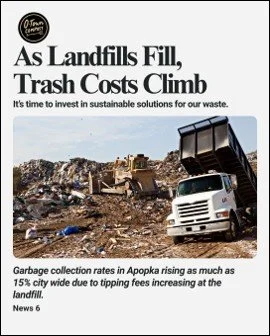
City officials cited rising operational expenses, including fuel costs, labor shortages, increased trash disposal costs and stricter environmental compliance, as the primary drivers behind the change.

The situation isn’t just isolated to Apopka. Orange County, which operates the Orange County Landfill, one of Central Florida’s largest disposal sites, has also raised its tipping fees over the past year and will continue to do so at 13% YOY. As of late 2025, the landfill charges waste haulers $54.20 per ton, up from $47 per ton this time last year. This increase trickles down to municipalities and private waste haulers, which then pass the cost onto residents and businesses who pay for trash. The Orange County Landfill serves not only unincorporated areas but also neighboring cities like Apopka and Orlando, meaning the financial impact reverberates across much of Central Florida and causes other garbage disposal sites to raise their prices.

These escalating costs highlight a broader trend across the state: as landfills reach capacity and environmental regulations tighten, the true price of waste is becoming harder to ignore.

O-Town Compost urges government officials to act now and invest in composting and recycling programs at the municipal-level. Also, it’s important to focus on public outreach and education to make sure people know how to properly sort their waste and minimize contamination. The longer we wait the higher the premium on permitted landfill capacity gets, and we get closer to a trash disposal crisis (currently happening in South Florida with Miami-Dade and Broward Counties where trash is being railed up to Georgia-area landfills). Let’s invest in waste diversion so future generations will have a better future.


If you have been happy with your service at O-Town Compost, please take a moment to leave us a Google Review. Click the image above or look us up on Google Maps to leave a review. Subscribers who leave a review with the name associated with their account will receive a $5 credit to their account. Thank You.


Commercial and Multi-Residential Composting Services in Alachua County and the City of #Gainesville.



Charlie Appears before Orlando City Council and Orange County Commissioner meetings to urge collaboration towards waste reduction goals.

By Charlie Pioli Owner O-Town Compost

Mayor Dyer, Commissioners. My name is Charlie Pioli. I’m a resident of this great City and own a business called O-Town Compost. I’m here today representing our 400 Orlando customers that source separate and recycle their food waste keeping it from the landfill.  Coincidentally, this means I’m talking about Mayor Dyer and his wife, Susie, who’ve composted over 1,000lbs with us! Nice job Mr. Mayor.

Four years ago, I started picking up buckets of food waste in my Camry using my garage as a warehouse, much to my girlfriend’s dismay. From day one, I’ve had my sights set high. It’s always been in our mission statement to assist the City in achieving their zero-waste goal.

From there, we’ve grown to become a financially sustainable business, collecting and composting 150 tons of food waste per month with a fleet of six vehicles, employing 10 men & women with competitive pay and benefits. We share a warehouse with 4 Roots in the Packing District, and are a key component to their mission of building healthy communities. We view food as a resource, and not as garbage. 

We’ve built a decentralized network of farms to process the food waste we collect into compost, making our routes more efficient. Our compost site partners are paid to process it and keep the finished compost to fertilize their sandy soils like nature intended it. It’s a win-win for our local ecosystem and economy.

Diverting 150 tons per month, is equivalent to about 15 less trucks heading down the 408 on their way to dump at the OCLF. While it’s significant, it’s only a drop in the bucket of the forty percent of the waste stream that is compostable. We’ve tried a long list of things to scale our impact, but without a commercial food waste ban, or a curbside Pay-As-You-Throw variable trash billing system, we’ve heard more “no’s” than “yes’s.” It’s no additional cost or savings for people to just trash their food scraps. Composting is seen as a feel-good service, and not a public utility like it ought to be. 

Orange County recently revealed that the landfill has 15-17 years left of capacity until we need to find a different disposal site. Regardless if the county permits another landfill or not, it will cost the City’s resident’s big time. The negative externality of landfilling our waste isn’t fully being realized yet, and we’re kicking the can down the road.

Although, we CAN extend the life of the landfill for another 15 years by exercising an aggressive diversion campaign that involves all hands-on-deck, a 3P strategy, and recovery programs for of all material streams. This option doesn’t involve any “silver bullet” solution, but a whole lot of education, public outreach, and infrastructure in an attempt to shift us away from a throw-away society.

It’s taken persistence from our team to educate the community about the importance of composting, and we’ll continue to play an important role in the City’s waste reduction efforts. We’re not composting for today; we’re composting for our future!


O-Town Compost now offers Bulk Compost Delivery!


O-Town Compost family with Mike at his Everoak Farm.

From left to right, standing: Nicole, Stephen, Charlie (Owner of O-Town Compost), Mike (Owner of Everoak Farm) , Delwin, Jamie, Ciana, Chrissy, Shem, John, Patrick, Sara.

From left to right, kneeling: Cristina, Angelika, Mary, Meredith, Erin

Photographer: Kristin Anderson


O-Town Compost does not take bio-plastics, but does accept paper, bagasse, wood, and bamboo products.