

Customer Feature - Kristi from the Hourglass District
Let's Be Honest - Your Office Goes Through A Lot of Coffee - Now Introducing Our Office Food Waste Collection Service!
O-Town Compost is now providing offices around Orlando with a way to divert their food waste, and an easy way to participate in corporate sustainability that aligns with their business values.
The food waste collection service is focused on being customized to meet each office’s needs. The number one priority is to avoid any pests or odors with routine pickups.
Once a week (or more, if needed), on Fridays before heading into the weekend, a member of O-Town Compost will empty the receptacle, replace the liner, and conduct an on-site cleaning of the bucket before hauling your lunch leftovers, coffee grounds, tea bags, and paper towels (among other items) to our composting site in East Orlando.
Every six months, our office clients will be given a report informing them of their waste diversion impact. Also, they can also choose to opt in to the occasional social media post on our Facebook, Instagram, and Twitter accounts publicizing how many pounds they’ve diverted. It’s a win-win for the earth and the reputation of your business!

With coffee consumption comes a plethora of grounds that are ideal for our compost.
Find Us at The Audubon Community Market!
We are pleased to announce that we will be hosting a booth at the Audubon Park Community Market on most Mondays! Our primary objective is to bring marketing awareness to our easy-to-use residential food waste pickup service, which takes Orlando’s food waste and converts it into rich compost for local farmers to grow more fresh food in.
At our booth, we will be soliciting two types of soil amendments for local area gardeners and urban farmers. This isn’t your granddad’s mushroom compost. Our two products are:
O-Town Black Gold - Our screened compost in 20 pound quantities for $10 apiece. This compost is high in organic matter and a direct result of people’s food waste being turned into a valuable humus to grow more food in
Revival Gardening’s Premium Worm Castings - A premium product that your plants will love! Sprinkle just a little on top of the soil around the plant, like a fertilizer, and watch it grow

Now Accepting Meat, Fish, and Dairy
For those who wonder what we accept, remember this slogan:
“If it grows, it goes.”
Basically, if it grew out of the ground, we will accept it in our compost program. The website’s FAQ page does a pretty good job at answers any questions you may have, but always feel free to contact us at info@o-towncompost.com.
Things We Do Compost:
Fruits and veggies
Coffee grounds, filters, and tea bags
Paper towels, napkins, and paper plates
Egg shells
Pasta and grains
Meat and bones
Cheese and other dairy products
Things We Do Not Compost:
Fruit stickers (please remove from produce before composting)
Pet waste including excrement or food
Paper cups
Kleenex or facial tissues
Any type of plastics including most bio-degradable plastics
Pesticide infused products for killing rodents or cockroaches

The law according to O-Town Compost.
Happy Holidays From O-Town Compost
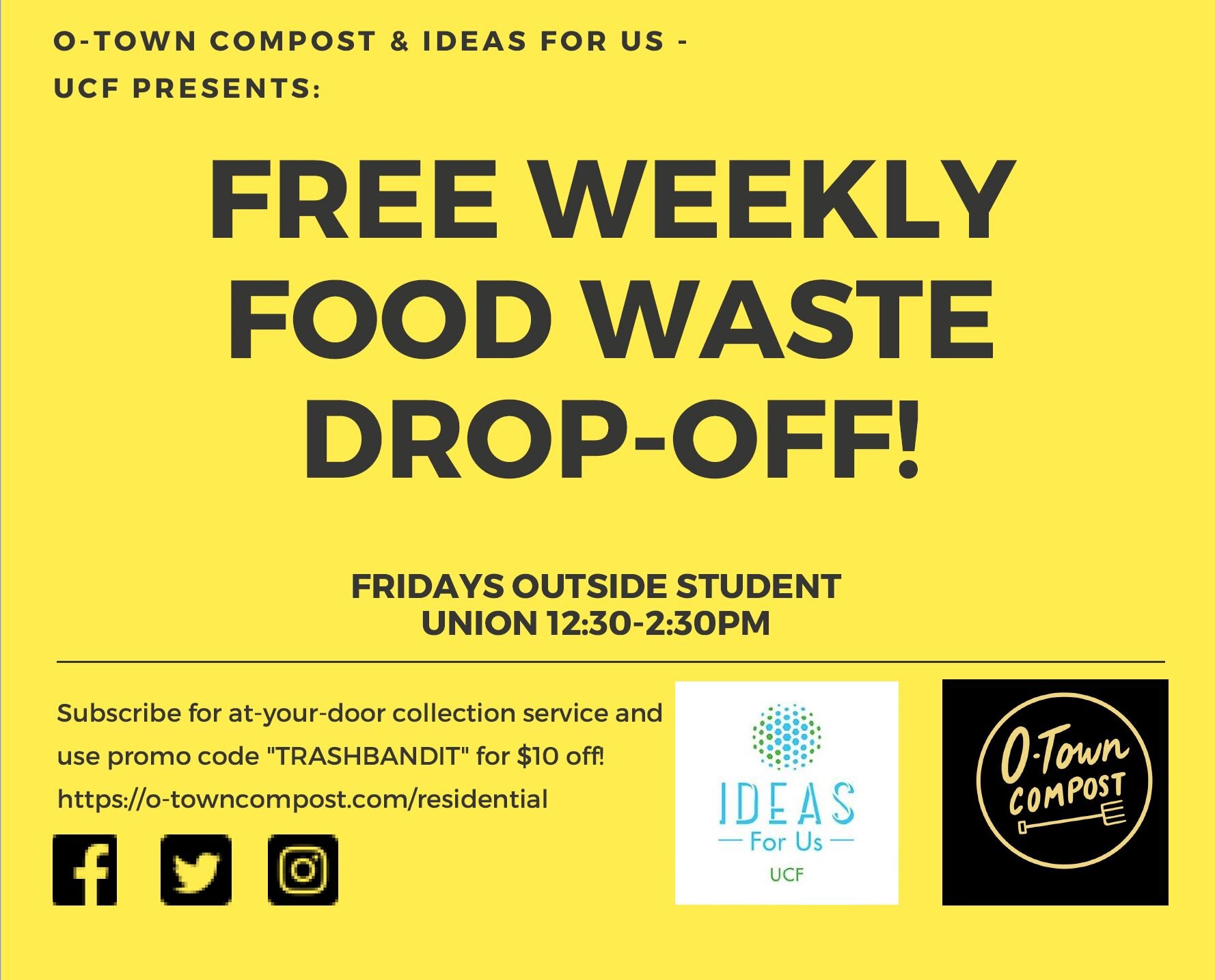
The holidays are meant to be a time for bringing people together, and showing appreciation for one another. We just want to say how immensely grateful we are for the support we’ve received from the people of Central Florida. Shout out to Orlando Permaculture, Ideas For US Orlando and UCF branches, East End Market, Cuplet Fern Chapter of Seminole County, Central Florida Fruit Society, friends and family who donated to our GoFundMe, and, of course, our subscribers!
We would be remiss if we didn’t say we have big plans for 2020. On the forefront of our minds is to continue our marketing campaign while educating people on the importance of composting and allow them to get over their unfounded fears of odors and rodents. Our other goals for The New Year involve;
We want to increase the volume of food waste we’re receiving to multiple tons per week
Making relationships with event planners, caterers, and venue spaces is essential for our Event Food Waste Recycling Program, and Zero Waste Event service
Office spaces, who generate food waste and coffee grounds in their break rooms, would be an ideal fit for our service. These corporate partnerships give firms an outlet to demonstrate their commitment to sustainability (#practicewhatyoupreach)
And lastly, residents on the West side of I-4, will soon be given the option to subscribe for O-Town Compost’s residential food waste collection service. We predict that by the summer of 2020, O-Town Compost will be servicing the zip codes of College Park, Windermere, Winter Gardens, Ocoee, and parts of Apoka.
Currently, our business operations are a new concept to a lot of people in Orlando. As people become more accustomed to us and our mission, we will inevitably grow. The 1,200 pounds of food waste we’ve diverted in the first month and a half of being open for business is really only a sliver of what’s out there. Cheers to a grimy and successful 2020!
Happy Holidays,
O-Town Compost Founder, Charlie Pioli

Why We Compost in Orlando
At O-Town Compost, we believe in a healthy balance of sustainable growth, which means giving back to the ecosystem what we take.
Orlando was once known for its agricultural presence. Citrus groves stretching as far as the eye could see, and farm land that sprawled from Apoka to Christmas with only a clump of buildings downtown to disrupt the horizon. Heck, I’ve even talked to an UCF alumni who remembers hitching up her horse outside her classrooms. Then, in 1971, Disney decided to open its famous resort and theme park, and the boom started.
Composting is a regenerative practice that allows us to bring back some of that natural habitat that we lost to development. Traditionally, compost replaces nutrients lost in the soil that were taken by the plants that eventually became our food. This fertility loss was replaced with organic compost after every crop cycle, introducing a cocktail of healthy bacteria and nutrients to began building the soil structure once again. It’s no joke when they say “it all starts with the soil.”
At the urban and suburban levels, reverting a small quarter acre lot from lawn to native habitat can invite bees, insects, butterflies, and birds completely altering the space to form a mini-ecosystem. That’s why at O-Town Compost we want to remain small and local to create mini-ecosystems of food waste collection to composting to growing food again. We are helping organizations and individuals change Orlando, pound by pound, into a hybrid between development and nature. A place where the ecosystem isn’t being wiped out, nor are the people being told to leave, but a coexistence. Sign up to start community composting in your neighborhood today!
Guiding Principles of Community Composting:
Resources recovered: Waste is reduced; food scraps and other organic materials are diverted from disposal and composted.
Locally based and closed loop: Organic materials are a community asset, and are generated and recycled into compost within the same neighborhood or community.
Organic materials returned to soils: Compost is used to enhance local soils, support local food production, and conserve natural ecology by improving soil structure and maintaining nutrients, carbon, and soil microorganisms.
Community-scaled and diverse: Composting infrastructure is diverse, distributed, and sustainable; systems are scaled to meet the needs of a self-defined community. (O-Town Compost is coming to West Orlando this summer!)
Community engaged, empowered, and educated: Compost programming engages and educates the community in food systems thinking, resource stewardship, or community sustainability, while providing solutions that empower individuals, businesses, and institutions to capture organic waste and retain it as a community resource.
Community supported: Aligns with community goals (such as healthy soils and healthy people) and is supported by the community it serves. The reverse is true, too; a community composting program supports community social, economic, and environmental well-being.
The Community Composting Movement Is Gaining Momentum
The founding of O-Town Compost was heavily influenced by other community composting operations around the country, like Bootstrap Compost in Boston, Let Us Compost in Athens, GA, and Rust Belt Riders in Cleveland. All are great examples of small local composters with a long list of residential subscribers who have been diverting massive quantities of food waste and making a positive contribution to their surrounding cities. The opportunity exists in every U.S. city, where successful organics programs are typically nowhere to be found, and the local governments are more focused on improving lagging recycling programs. Food waste management has been left to the private sector to deal with in large part.
Typically, the large waste haulers (a.k.a. Big Waste), like Waste Management and Republic Services, would get involved in the action, but since they have a constant inflow of trash into their landfills and incinerators, they’re okay with the status quo. Food waste is heavy after all, and the more tonnage coming into the landfill means more revenue. Although, it’s doubtful that these big companies will remain on the sidelines for long. In the meantime, small micro-haulers are carving out a niche in cities across the East Coast, South, and Mid-West.

Community Composters around the U.S.
The Institute of Local Self Reliance (ILSR) has been an instrumental part of the composting movement with their “Composting For Community” Podcast, and the organization of webinars and conferences to bring the nation’s decentralized composters together for sharing knowledge. One of ILSR’s feature writers, Neil Seldman, has been a force in his activism and criticism against Big Waste for years. Mr. Seldman’s article in December of 2018, “Monopoly and the U.S. Waste Knot” inspired O-Town Compost’s founder to look differently at the waste industry he was part of and at current U.S. recycling practices. Ultimately, recycling has suffered since the introduction of single stream, which was a recycling program talked up by large waste haulers looking to vertically integrate their collection systems. If you’re interested in making the greatest environmental impact, diverting food waste is the clear winner over standard recycling. Thus, O-Town Compost was born with food waste in mind, and the wind at our backs. Seemingly, there is unimaginable potential to repair Orlando’s eco-system and shift away from landfill waste management in Orange County, FL.
O-Town Compost Comes To East Orlando

Shockingly, Americans waste about a pound of food per day, meaning that the average household generates around four pounds per day. O-Town Compost’s mission is to provide Orlando with a solution to this problem in their Residential/Small Office Service. It’s a convenient way for busy people to do the right thing while not taking any additional time out of their day. Just like Trash and Recycling Day, you have O-Town Compost Day, where we’ll come swap out your bucket for a clean one, and take your food waste back to be turned into finished compost. Don’t feel bad anymore if you want to throw out grandma’s casserole!